
Can the Human Spirit Vs. Oppression Outrun an Empire of Control
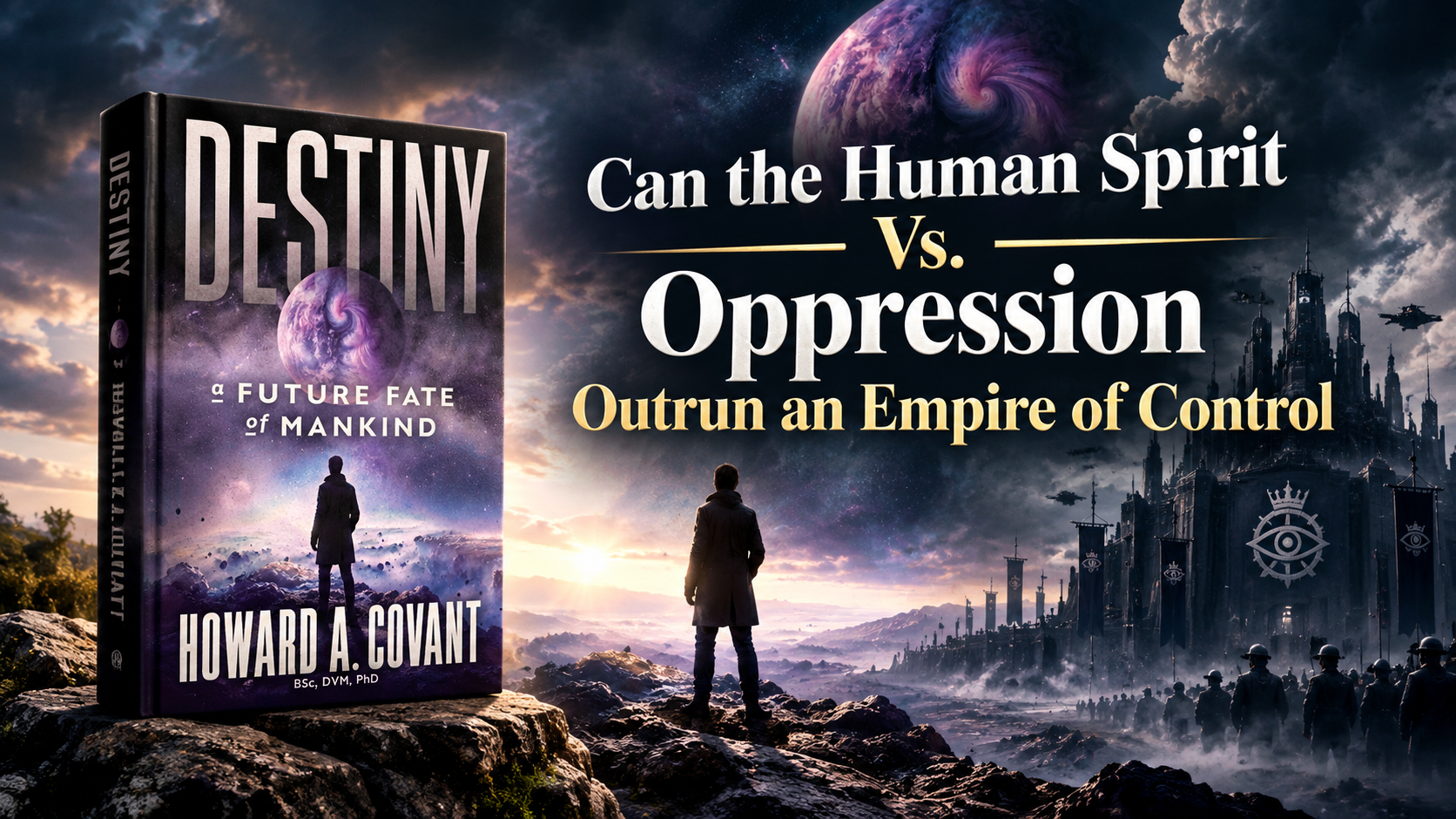

Every empire needs something to crush. In Destiny: A Future Fate of Mankind, that something is a scientist named Dr. Martin Tabir. So the story is really about the human spirit vs. oppression. It’s told through a man who won’t stay quiet. Dr. Howard A. Covant wrote this book. But first, he spent decades in emergency veterinary medicine. He also worked in biomedical research. That background doesn’t show up in plot twists. Instead, it shows up in how the book treats control. Both political and biological control.
Why The Human Spirit Vs. Oppression Sits at the Center of the Story
Tabir doesn’t start the book as a rebel. He starts it as a regular man. He has lived his whole life under a system that works. People live longer. Disease is mostly gone. Communication is instant. But there’s a catch. All of it runs through the Orthodox Republican Empire. This is a thousand-year-old regime. It trades comfort for obedience. So readers who like The Handmaid’s Tale or Dune will know this shape already. In both, a working society hides a rotten bargain underneath.
Still, the empire isn’t cartoonishly evil. It solved real problems. That’s the uncomfortable part. After all, a regime that cures disease has a strong case for itself. It’s stronger than one that oppresses for no reason. As a result, Tabir’s choice actually matters. He has to weigh a working system against an unproven idea of freedom. And the book never pretends that trade is easy.
The Orthodox Republican Empire, and Why It Feels Plausible
A lot of dystopian sci-fi leans on fear alone. But the Orthodox Republican Empire sci-fi setting in Destiny does something different. Implanted microchips grant near-perfect health. They also grant instant communication. Because of this, the empire’s grip isn’t just military. It’s medical too. It’s built into daily life. In other words, you can’t easily leave a system that keeps you alive.
This detail matters more than it seems. Dr. Covant’s career included advanced surgical work. It also included biomedical innovation. So you can feel that experience in the microchip technology. It’s not treated as magic. Instead, it’s treated as a tool. A tool that doubles as a leash. Ask yourself this. If a government offered guaranteed health in exchange for obedience, how long would you hold out?
Aboard the Space ARK-New Eden
Once Tabir is freed, the story shifts. It becomes a future fate science fiction book built around one fragile mission. He’s tasked with reading deep-space signals. Because of that job, he ends up aboard the Space ARK-New Eden. This ship carries what’s left of humanity’s hope.
This is where Destiny stops being one man’s escape story. Instead, it becomes a science fiction novel on future fate in a much bigger sense. The stakes stop being personal. Now they’re about species survival. Some review sites tag it as high-stakes adventure light-hearted satire. But Destiny only earns the first half of that label. There’s very little satire here. Even when the crew reaches strange alien worlds, the tone stays serious.
Freedom, Control, and the Trade-Offs Neither Side Escapes
It would be easy to land on a tidy message here. Freedom good, control bad, roll credits. But Destiny mostly skips that trap. The empire’s order actually works. Longevity, health and stability are all real. Meanwhile, the ARK’s freedom guarantees nothing. Nobody on that ship knows if a livable world even exists. And they don’t know what will greet them if they find one.
This is maybe the most interesting choice in the book. Dr. Covant doesn’t treat freedom as automatically better. Instead, he treats it as a bet. That bet costs something real. So the crew of the New Eden pays for it. The book won’t rush to resolve that cost. Whether the bet pays off stays an open question.
A Debut Shaped by Decades in Medicine, Not Fiction
None of this world came from reading space opera. Instead, it came from somewhere else. Dr. Covant holds doctorates in Veterinary Medicine and Biomedical Sciences. His career ran through emergency veterinary care. It also ran through marine mammal medicine and civil advocacy. This was long before Destiny existed as a book. He was also born during the Apollo Moon Missions era. People often say that’s the spark behind his love of space. Even so, the book’s real backbone is medical, not astronomical.
That’s partly why Destiny reads as science fiction about humanity’s future. It’s not just a simple space adventure. The empire’s control tool is medical technology. The moral tension is about bodies and health. So a scientist writing about a health-based regime isn’t a coincidence. In fact, it’s the clearest fingerprint Dr. Covant leaves on the page.
Conclusion
The human spirit vs. oppression isn’t a new theme in storytelling across cultures and eras, yet it gains fresh intensity when characters confront systems that blur moral lines and force painful compromises on every side. But Destiny earns its place anyway. It does this by refusing to make the oppressive side obviously wrong. So readers hoping for a clean hero’s story might end up arguing with the book instead. That’s probably the point. Whether Tabir’s gamble was worth the cost stays open long after the last page.
Frequently Asked Questions
Is Destiny: A Future Fate of Mankind based on real science? Partly, yes. The health tech draws on Dr. Covant’s real background in biomedical sciences. Still, the story itself is fiction.
What is the Orthodox Republican Empire in the book? It’s the regime controlling humanity’s solar system settlements. It enforces obedience through religious doctrine. It also enforces obedience through medical technology.
Does the book resolve the human spirit vs. oppression conflict cleanly? No, it doesn’t. Destiny shows the empire’s order as genuinely functional. Meanwhile, it shows the crew’s freedom as genuinely uncertain.
Who is Dr. Martin Tabir? He’s the scientist at the center of Destiny. He’s freed from the Orthodox Republican Empire’s control. Then he’s sent aboard the Space ARK-New Eden to find answers about humanity’s future.
