
Born Under Apollo Skies Made a Hard Science Fiction Author

The Short Version
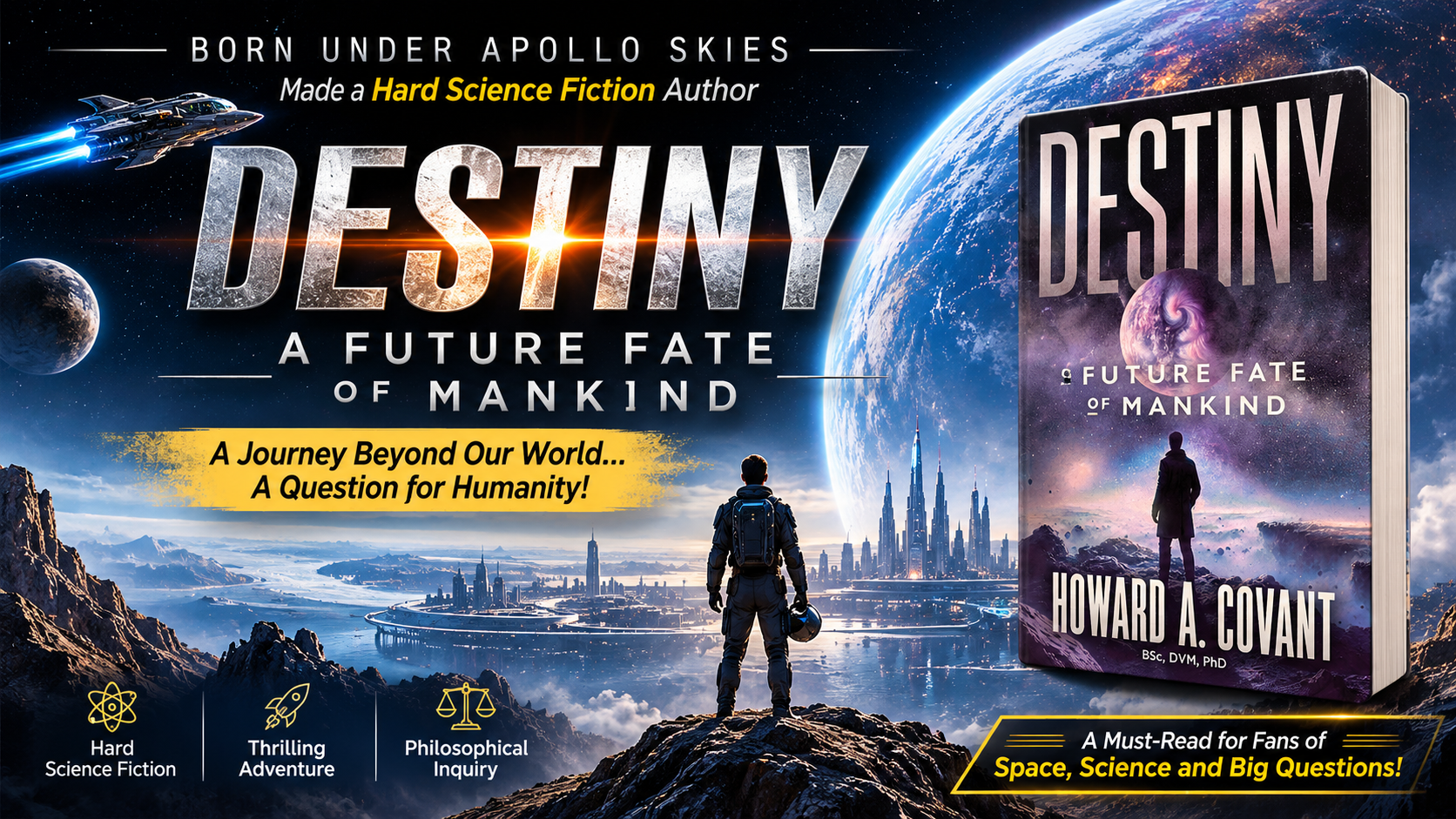
Destiny: A Future Fate of Mankind is the debut novel of Dr. Howard A. Covant. It sends a freed scientist into deep space. Then it asks what we owe the systems that keep us alive. This post covers science, the moral knot, and the mission. But you won’t get a verdict. Instead, you get a setup and a few honest limits. After that, you can decide if the book suits you.
Introduction
You have likely read a space story that faded within a week. The ride was fun, but nothing stayed. Now and then, though, a book sticks. If that’s what you want, the hard science fiction author behind Destiny is worth a look. Dr. Howard A. Covant trained in two fields. He earned a doctorate in each: Veterinary Medicine and Biomedical Sciences. Destiny is his first novel. So why would a medical scientist add starships to his résumé? The answer starts with his birth year. He was born during the Apollo Moon Missions era. Still, that is only the start.
How a Hard Science Fiction Author Builds a Future From Medical Training
Start with the career. Marine mammals, emergency cases and advanced surgery all sit on his résumé. So do biomedical innovation and civil advocacy. That is a lot of ground. Still, most of it comes back to living bodies and quick choices. Work like that asks for fast calls. Because of that, those same worries drive his novel.
Space reached him from another side. One interest pulled his eyes up, while the other kept his hands busy with living things. In Destiny, the two finally meet on one page.
How Hard Is Hard?
Hard science fiction ties its ideas to real science. The author’s site calls Destiny a blend of hard science fiction, thrilling adventure and philosophical inquiry. We can’t check every detail for you. For example, a bioengineer could argue about one implant. Still, the source of the ideas is clear. A person with two doctorates in life science wrote this story. As a result, medicine steers the plot. That shows in what the book fears.
Humanity and Technology Science Fiction Starts With One Implant
Picture the world he built. People live across the solar system. They live longer and talk instantly. They also stay in near-perfect health. Implanted microchips do all of it. Would you say yes? Most of us would, and fast.
But there is a catch. The Orthodox Republican Empire has held power for a thousand years. It enforces religious obedience. It also meets dissent with force. So the same society that beat disease also polices belief. Both facts sit side by side, yet neither cancels the other.
Now think about a pacemaker. Few people would refuse one. Yet add one more question: who else has a say in how it works? The novel keeps circling that idea. In fact, it is humanity and technology science fiction at its plainest. One small device holds a comfort and a price tag.
The Mission That Pulls Dr. Tabir Out
Dr. Martin Tabir gets free of the Empire’s control. But his freedom comes with homework. Strange signals from deep space need a reader. He is the one assigned. Then his work puts him aboard the Space ARK-New Eden. The ship holds the last chance humanity has at freedom. Its goal is a new home outside our solar system.
Fans of intergalactic civilization sci-fi will know this shape. There is a ship, a signal and a home nobody has seen yet. Meanwhile, the book’s own description promises alien worlds and real danger. We’ll leave those for you to find.
Also, it is science fiction about humanity’s future in a literal way. Picture reading a message that could change everything. Humanity’s best hope rides on one vessel. Because of that, no choice on board feels small.
Thought-Provoking Sci-Fi Novels Ask Before They Answer
Maybe you liked The Expanse, Dune or Blade Runner 2049. If so, you know the pull. First, the spectacle arrives. Then a quiet question slips in underneath. Destiny aims for that mix. Its site lists survival, ethics and the balance between progress and responsibility as themes.
Progress and responsibility rarely agree. Many stories pick a side and move on. This one does not seem built that way. Instead, it asks you to hold both ideas at once. After all, that is what makes thought-provoking sci-fi novels worth the time. Also, it won’t choose for you.
A Fair Warning
Not every reader wants that. Some people read to escape. If that’s you, a story this focused on moral weight may feel heavy. Even so, try it on a quiet evening. Treat it as a hard science fiction book with a conscience. Then you’ll know what you’re getting.
What the Charts Said
The author’s site reports some early wins. Destiny ranked number one in Sci-fi Galactic Empire ebooks. It ranked number two in space exploration ebooks and number three in Sci-fi adventure. All of that came within two weeks. After three weeks, the site says the book hit number one on Amazon. Still, those are the author’s own figures, so weigh them that way. Also, because rankings rise and fall daily, a chart can’t tell you if this story fits you. Instead, your own taste decides that.
Conclusion
A hard science fiction author usually wants you to leave with a question. Dr. Covant seems to want the same. So here is one to carry in. Say a chip could promise you a long, healthy life. Now say someone else held the controls. Then would you still say yes? But your answer might shift before the last page. That’s fine.
Questions Readers Ask
What does “hard” mean for a hard science fiction author, and does Destiny qualify?
Hard science fiction ties its ideas to real science as closely as it can. The author’s site calls Destiny hard science fiction with adventure and big questions. Still, you’ll have to judge the fit yourself.
Where can I buy Destiny?
Use the Buy Now button on the author’s site. It leads to the book’s product page. Also, the site shows an Amazon logo beside it.
Do I need a medical background to follow the microchips?
No, the premise doesn’t call for one. Implanted chips keep people healthy for a long time. They also let people talk instantly. Instead, the harder puzzle is who gains and what it costs.
What are the signals Dr. Tabir has to decode?
The author’s site calls them mysterious signals from deep space. It says nothing more. So the book keeps the rest for you.
How can I follow the author’s news?
The homepage has a newsletter signup near the bottom. It also links to the author’s pages on Facebook, LinkedIn, Instagram, Pinterest, YouTube and TikTok.
