
Prayer Pays for Health in Orthodox Republican Empire Sci-Fi
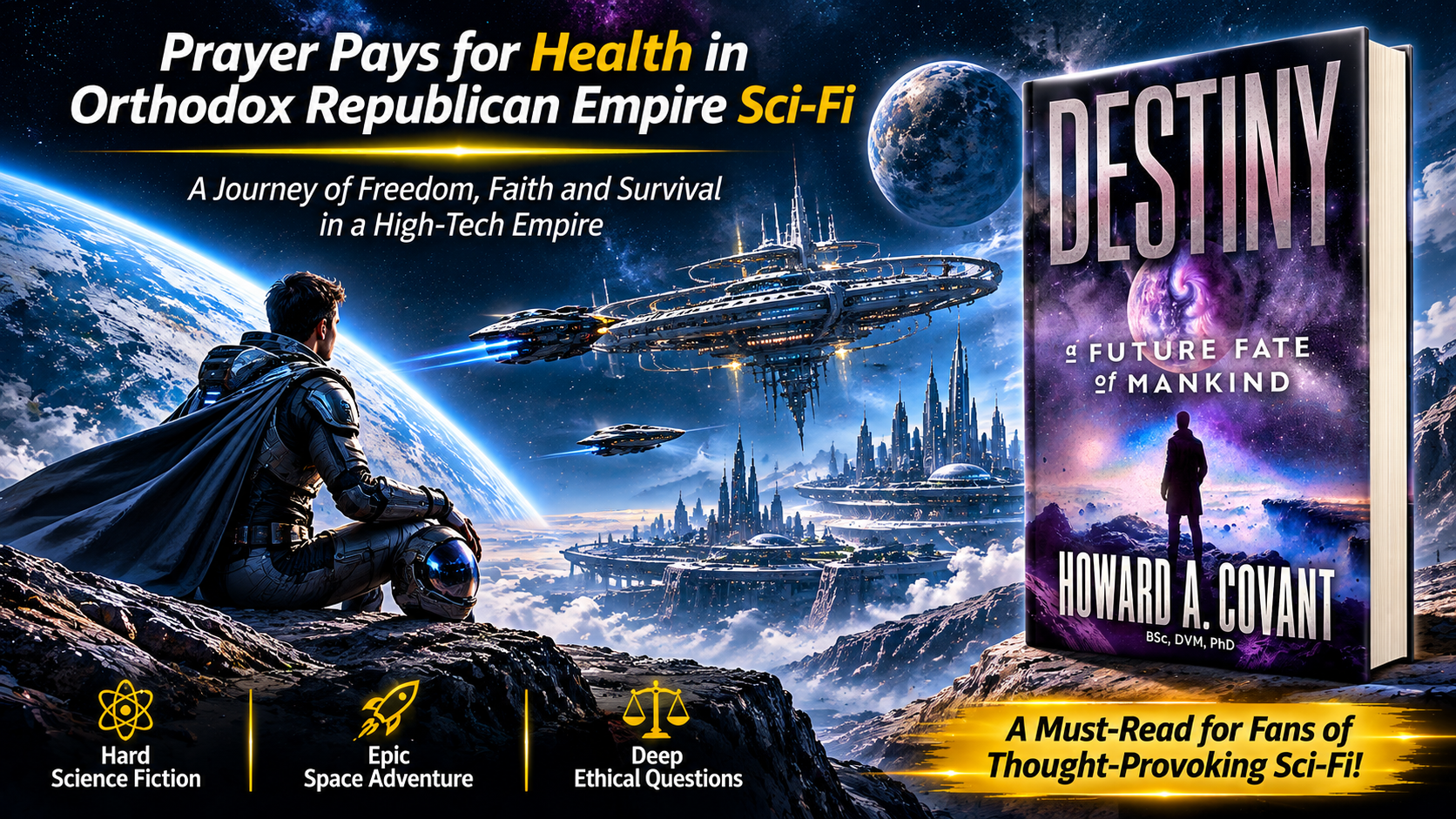

The Quick Read
A scientist breaks free of an empire that keeps everyone healthy, as long as they obey. Now he’s on a ship bound for a new home. This post covers how that world works, who wrote it, and what hard questions the book raises, all spoiler-free, so you can decide if it’s your kind of read.
A Quick Word Before You Dive In
Some villains are easy to spot. They shout and wear black. But what if the ruler is also the reason you feel well? That odd pull drives Orthodox Republican Empire Sci-Fi, and Destiny: A Future Fate of Mankind leans on it hard. Dr. Howard A. Covant wrote it as his debut novel. So you get a fresh voice, not a long-running franchise. Still, the setup is the real hook. A regime has held power for a thousand years. Then one man slips free.
Why Orthodox Republican Empire Sci-Fi Feels So Uneasy
First, look at what people get. Humanity has spread across the solar system. People live longer and stay in near-perfect health. They also talk to each other in an instant. Implanted microchips make it work. So who wouldn’t sign up?
What the Empire Asks in Return
Next, look at who runs the place. The Orthodox Republican Empire has lasted a thousand years. It demands religious obedience. The book sets that beside the gift of health. Then it lets you feel the clash. Instead, it’s a system you might thank at breakfast, not a monster in a cave.
Picture a hospital wristband you can never cut off. Maybe it keeps you safe. Maybe it keeps you in line. So the setup invites you to ask which. That is science fiction about humanity’s future at its sharpest. In fact, it asks less about what we might build and more about what we might put up with.
Meet the Man Who Gets Out
Dr. Martin Tabir is freed from the Empire’s control. At first, that sounds like a happy ending. Instead, it is where trouble starts. His first act of freedom is to listen. Strange signals from deep space need decoding, so the task is his. Pick up the Dr. Martin Tabir Destiny book and you follow a scientist. He is stepping out from under a system that held him. He has skill and a mission. But he doesn’t yet have answers.
A Futuristic Space Exploration Novel Built Around One Ship
Then the story leaves home. Tabir sails on the Space ARK-New Eden. If freedom has a last chance, this ship carries it. Its aim is a new home past the edge of our solar system. So the plot has a clear heading. Think of a road trip where nobody has seen the destination. The book’s own description also adds alien worlds and real danger. But we won’t spoil which ones.
A Sci Fi Book by Veterinarian Writer Sounds Odd. Is It?
It sounds like a joke pitch. Yet look at the training. Dr. Covant earned doctorates in Veterinary Medicine and Biomedical Sciences. His work has covered emergency veterinary care, marine mammal medicine and advanced surgical procedures. It has also covered biomedical innovation and civil advocacy. So that is a long run of jobs where a wrong call has a price.
What the Training Gives the Story
Think about what a surgeon weighs. There’s risk, benefit, and who gets to decide. After all, those same three things sit at the center of Destiny. The site lists survival, ethics, and the balance between progress and responsibility as themes. So the match feels natural. He was also born during the Apollo Moon Missions era. Space, it seems, has been pulling at him since day one.
What It Can’t Promise
A medical background doesn’t make every chip detail real. We can’t say how closely each idea tracks today’s science. Implanted devices exist now. But none give near-perfect health or instant talk across the solar system. So treat the tech as fiction shaped by medical know-how. Still, that is a fair deal for a story.
Is This Your Kind of Book?
If The Expanse, Dune or Blade Runner 2049 sit on your favorites list, this may suit you. Those stories pair big worlds with uneasy questions. Likewise, Destiny mixes adventure with ethics. It’s a futuristic space exploration novel first, so there’s real motion. But the questions never leave the room.
If you collect books about humanity’s fate and mankind, it adds a debut voice to the pile. It’s also a sci-fi book by a veterinarian writer, so the author knows bodies, not just ships.
If You Read for Fight Scenes
Still, if you read mostly for fight scenes, expect to sit with some tough questions. That may not be a bad trade. But it is a trade.
About Those Rankings
The author’s site says Destiny ranked #1 in Sci-fi Galactic Empire ebooks, #2 in space exploration ebooks and #3 in Sci-fi adventure within two weeks. It also says the book reached #1 on Amazon after three weeks. That’s the author’s side of the story, so check the live listing yourself. Charts move often. But no chart can tell you whether you’ll love the book.
Conclusion
Orthodox Republican Empire Sci-Fi works best when the empire isn’t a cartoon. In fact, the setup suggests Destiny knows that. You get a freed scientist, a ship and a very old regime. But you don’t get a promise of a tidy ending. So take this question with you. If your health came free and your beliefs came with strings, which would you give up first?
Five Quick Answers
Is Orthodox Republican Empire Sci-Fi a fair label for Destiny?
Partly. The Empire is the pressure that shapes everything. But the story also follows a voyage and a set of signals. So the label fits one big piece, not the whole book.
Are the chart rankings still current?
Not necessarily. The figures come from the author’s site and cover the first two or three weeks. Still, rankings shift, so look at the retailer page for today’s numbers.
What role does religion play in the story?
The Empire demands religious obedience, according to the author’s site. Beyond that, the site doesn’t spell out more. So the book itself holds the rest.
Is Destiny hopeful or bleak?
Both, at least on paper. The ship carries humanity’s last hope for freedom. Yet the themes include survival and hard ethical trade-offs. So hope is there, but it isn’t free.
What should I ask myself while reading?
Try three questions. First, who benefits from the comfort? Next, who gets to say no? Then, what would you pay to keep both health and choice?
