

Look around the next time you ride public transit.
The person sitting across from you is staring at a screen. The person beside them is doing the same. Across the aisle, someone is listening to music through earbuds, another is typing furiously with both thumbs, and someone else is playing a game.
We barely notice it anymore.
Our smartphones have become such an integral part of everyday life that we rarely think about how extraordinary they would have seemed only a few decades ago. They communicate with almost anyone on Earth, provide instant access to virtually unlimited information, entertain us, navigate for us, monitor our health and keep track of our appointments, finances and relationships.
We have, in effect, created an external electronic extension of ourselves.
Now imagine removing the screen.
Imagine that instead of reaching into your pocket, you simply think.
The information appears in your mind.
You want to contact someone? Think it.
You want an answer to a question? Think it.
You want directions, entertainment, medical information or a restaurant reservation? Your personal AI already knows your preferences and handles it.
Now take the idea one step further.
What if that system could continuously monitor your physiology, respond to changes in your body, communicate directly with your nervous system—and even have its own personality?
At that point, we would no longer be talking about a smartphone.
We would be talking about something much closer to PIP.
PIP is the artificial intelligence implanted within Dr. Martin Tabir in my novel Destiny: A Future Fate of Mankind. PIP is opinionated, sometimes humorous and occasionally inconvenient. But PIP is far more than a sophisticated computer. He represents the possibility of technology becoming an intimate part of human existence.

When I first conceived Destiny, this was complete science fiction.
Today, some of the science behind the idea is becoming very real.
When Biology Becomes the Computer
Recent developments in biological computing are particularly fascinating.
Researchers have demonstrated that living human neurons can be integrated with silicon-based computer systems and used to perform computational tasks.
In one remarkable experiment, approximately 200,000 living human neurons were grown on a silicon chip and connected to a computer system. The neurons were trained to interact with Doom, the classic first-person shooter, and were able to respond to their environment and improve their performance through experience.
Think about that for a moment.
Living human brain cells were taught to play a computer game.
The system is obviously nowhere near replacing a human gamer—and certainly nowhere near becoming PIP. But it demonstrates something profound: living neurons can be incorporated into computing systems and can learn through interaction with their environment.
Scientists are interested in much more than teaching neurons to play video games. Biological neurons are remarkably efficient information-processing systems, and researchers are exploring whether they can perform certain forms of computation while consuming far less energy than conventional computers.
The technology is already moving beyond the laboratory. In Singapore, the National University of Singapore, DayOne and Cortical Labs have developed a prototype biological data centre using living neurons integrated with computing technology. The project is exploring biological computing as a potential new approach to data processing and artificial intelligence.
We are still a very long way from anything resembling PIP.
But the important point is this:
The fundamental concept is no longer purely imaginary.
And That Should Make Us Think
There is a tendency to become fascinated by what technology can accomplish while forgetting to ask whether we should accomplish it.
An implanted device capable of monitoring our bodies, communicating with us, interpreting information and interacting with artificial intelligence could provide extraordinary benefits. It could improve health, make communication almost instantaneous and expand human capabilities in ways we can barely imagine.
But the same technology could also create unprecedented opportunities for surveillance and control.
Who owns the information generated by your body?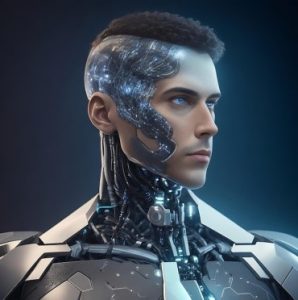 Who controls the AI inside your head?
Could someone else access it?
Could it be manipulated?
Could an authoritarian government use such technology not merely to monitor its citizens—but to influence them?
These are not simply technological questions. They are questions about freedom, privacy, ethics and what it means to be human.
They are also central to Destiny.
The world I created in the novel has achieved extraordinary technological advancement. Humanity has conquered many diseases, extended life and developed technologies that would seem miraculous to us today.
Yet humanity has not necessarily become wiser.
That distinction is important.
Technological progress does not automatically produce human progress.
We can become better at building machines without becoming better at understanding ourselves.
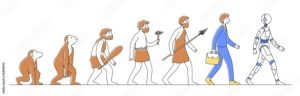
The smartphone in your hand may seem remarkably advanced today, but compared with PIP, it may one day seem as primitive as an abacus does to us now.
And perhaps it is already the beginning of that journey.
We are allowing machines to know where we are, what we like, what we search for, what we buy and who we communicate with. The next step may be moving that technology from our pockets into our biology.
The question is whether we will be wise enough to preserve our humanity as we do so.
That is one of the ideas I wanted to explore in Destiny: A Future Fate of Mankind. It is a story of scientific discovery, adventure, love, loss, humour and mystery—but beneath all of that lies a much larger question:
If humanity gains the ability to transform itself through technology, will we use that power to become more human—or less?
Perhaps more importantly, what defines humanity? Will the goals and ideals we hold today remain the same for our future selves?
Perhaps the future is not predetermined.
Perhaps, as I suggest throughout Destiny, fate presents us with circumstances, but destiny is shaped by the choices we make in response to them.
And those choices may already be beginning.
Howard A. Covant, B.Sc., D.V.M., Ph.D.
 Further Reading
- Human Neurons Learning to Play Doom
Deni Ellis Béchard, Scientific American, “How human neurons on a chip learned to play Doom.” The article describes Cortical Labs’ work using approximately 200,000 living human neurons on a silicon chip and explores the implications for biological computing. - Cortical Labs — Biological Computing
Cortical Labs explains its approach to biological computing, including its CL1 system, in which living neurons are cultivated directly on a silicon chip and connected to computer systems. - Singapore Biological Data Centre Prototype
National University of Singapore Medicine, “NUS Medicine, DayOne and Cortical Labs Unveil Biological Data Center Prototype in Singapore,” August 17, 2026. The announcement describes the prototype and its potential role in developing biological computing technologies.
